Hello LSC.
At the end of each season, we like to take some time to recap the efforts of the Lake St. Catherine Association (LSCA) and our partners during the year. This work is performed on behalf of the lake community and our membership as we endeavor to fulfill our mission of the preservation, protection, and maintenance of Lake St. Catherine.
What you’ll read below are short summaries of some of the projects and activities from 2025, but we encourage you to visit our website and click on our Blog to read more detailed accounts for all these efforts.
We hope you can get comfy, and spend a few minutes reading on for our 2025 Year In Review.

A Thank You To Our Partners
The LSCA would like to thank the Poultney Mettowee Natural Resources Conservation District (PMNRCD) and their excellent staff, Fitzgerald Environmental Associates (FEA), Limnologist Emily Porter-Goff, the Towns of Wells & Poultney, the Wells Village Library, the LSC State Park, the Vermont Center for Ecostudies, the Lake Champlain Basin Program (LCBP) & NEIWPCC, all the departments under the Vermont Agency of Natural Resources, our State Representatives & Senators, and the Federation of Vermont Lakes and Ponds (FOVLAP) for their efforts in support of Lake St. Catherine in 2025. We greatly appreciate your support!
Membership & Donations
Thank you to everyone who contributed to the LSCA this year through memberships and donations - we have a great community of lake stewards who are invested in preserving, protecting, and maintaining beautiful Lake St. Catherine! Your contributions are critically important to help fund our numerous lake management programs which you’ll read more about below.
As of this writing, we have 383 members who contributed a total of $77,816, giving us an average contribution of over $200. While we didn’t hit our goal of 400 members, we had another great fundraising year.
Can we crack the 400 member mark next year? This will again be our goal as we continue to reach out to LSC property owners, and hope to expand our reach with membership levels for family members of property owners, renters, and those who use the lake for recreation.
We’d also like to thank camp owner Andrew Gioulis for his fantastic design of our 2025 Membership gift, this beautiful 3" x 3" iron-on patch depicting a LSC brown trout. We are so happy that our members are enjoying the patches! Andrew has also designed the 2026 patch which looks fantastic! Get a sneak peek of the patch, as part of the 2026 Membership Package, pictured at the end of the post.
Thank you for your support!

Grants - Working To Bring Funds To Lake St. Catherine
The LSCA has been working hard throughout 2025 to bring grant funds to Lake St. Catherine for 2025.
This year, we were able to use grants earned through the Lake Champlain Basin Program (LCBP) & NEIWPCC, to help partially fund the Greeter Program and the Milfoil Control Program’s DASH team ($25,000), and to purchase water testing equipment for the lake ($13,000). We also earned a grant through the State’s Grant-In-Aid Program for $25,000 to also help partially fund the Greeter Program and the Milfoil Control Program’s DASH team.
In partnership with PMNRCD, previously earned grant funding from the LCBP was also used in 2025 to help fund the Lake Wise Program, the LSC Stormwater Master Plan, and the LSC Watershed Action Plan. Additional information about these initiatives are included below.
For 2025, we have already applied for the Aquatic Invasive Species Spread Prevention and Management grant from the LCBP, and we will again be applying for the State of Vermont’s Grant-In-Aid program - both of which will help to partially fund our Greeter Program and our DASH team. We have also applied for two other grants from the LCBP which would help to fund the Lake Wise Program over the next 2 years.
We also plan on applying for grants through our region’s Clean Water Service Provider to fund final designs for multiple stormwater projects that were developed through the LSC Stormwater Masterplan and the Watershed Action Plan. Once final designs are developed, we will be able to apply for additional funding for implementation of the projects.
We’ll let you know how we do!
Greeter Program
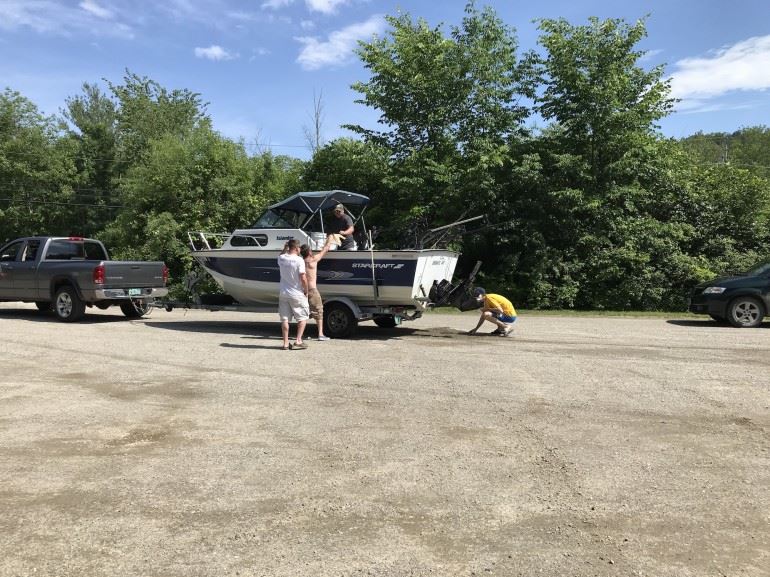
Our Greeter Program is very important to the health of Lake St. Catherine. Our Greeters have been trained to identify aquatic invasive species (AIS) - like spiny waterflea, golden clams, water chestnut, starry stonewort and zebra mussels - to stop them from entering LSC at the Public Access boat launch in Wells. They also educate boaters about the importance of looking for these invasives on their boat or trailer so they are not spread to LSC or another lake. Each year, they do a fantastic job checking vessels and educating the lake community on the dangers of invasive species for Lake St. Catherine.
Traditionally, our Greeters have been on duty from Memorial Day through Labor Day - working on Friday, Saturday and Sunday, while also covering holidays and fishing tournaments. In 2025, using grant funds earned from the LCBP, and the State’s Grant-In-Aid Program, and membership contributions, for the first time ever, we were able to staff almost all days between Memorial Day and Labor Day.
In total, our Greeters greeted 1,335 vessels throughout the 2025 season.
Thank you to our Greeter team! They work hard each season to keep AIS out of Lake St. Catherine.
Sediment Testing
In August of 2024, working with our limnologist and the DEC, we collected a sediment sample from the deepest part of the lake to analyze the diatoms contained in the sediment. Diatoms are algae with silica cell walls, they produce 20-30% of the air we breathe, and they produce long-chain fatty acids (these molecules are food for the entire food web, from zooplankton to aquatic insects to fish).
By analyzing the diatoms in the different layers of the sediment, we can infer what water quality conditions may have been like prior to colonization.
After reviewing the results we received from two testing laboratories in early 2025, our limnologist concluded:
-
The oldest layer of the sediment sample collected was dated to 1850
-
The Lake received a rapid influx of additional sediment between the years of 1875 and 1920, possibly due to clearcutting around the lake, reported forest fires during this timeframe, and the emergence of the quarrying industry
-
Diatom inferred phosphorus levels in the bottom layer was 6 µg/l, and 12 µg/l in the top layer. This means that in the past 175 years, LSC has doubled its concentration of phosphorus, and pre-colonial concentrations would likely be even lower.
-
Unfortunately, an invasive diatom (Lindavia comensis from northern Europe) was discovered during the testing. This diatom is now the dominant diatom in the lake which makes LSC’s rating on the Lake Diatom Condition Index as ‘Poor’.
Based on these results, we have seen that LSC’s phosphorus levels have doubled since 1850. This is why the multiple stormwater mitigation programs the LSCA and our partners are working on are so important for the lake. We need to work to “turn off the spigot” so that stormwater is not carrying phosphorus into the lake.
The invasive diatom that was discovered is problematic because of the impact it can have on the food chain. Healthy ecosystems have high diversity, and this invasive diatom has significantly impacted that diversity. Since diatoms are a primary producer (the beginning of the food chain), there are likely to be primary consumers (herbivores, the critters who eat nothing but algae) who won't be able to eat this invasive species, so they can die out. Then, there will likely be secondary consumers (scavengers or predators, those that eat herbivores) who won't be able to find food they can eat, and so on up the food chain, which can cause loss of diversity all the way up. The LSCA will start macroinvertebrate monitoring in 2026 as part of the water testing grant we earned this year.

Lay Monitoring & Water Testing
The LSCA has participated in the Vermont DEC's Lay Monitoring Program since its inception, and has assisted in collecting four decades of water data on LSC. LSCA Trustees collect bi-weekly water samples from Big Lake and Little Lake from Memorial Day to Labor Day each season which are sent to the DEC for testing.
The water is tested for phosphorus, clarity (secchi depth), chlorophyll-a (algae), and as of 2023, caffeine. You can review the data from the Big Lake (since 1979) and Little Lake (since 2009) by visiting the Lay Monitoring Lake Water Quality Data website. When on this page, select 'Wells' from the 'Select Town' dropdown, and Big Lake and Little Lake data will be available to view.
Based on this data, the DEC recently provided us with some trend charts showing that these values since 2000 have been stable, and noting that our summer phosphorus levels were significantly improving.
In 2026, we’ll be increasing our water quality data collection using a grant earned from the LCBP. This grant has allowed us to purchase 3 in-lake loggers, one for each basin of the lake, which will collect continuous conductivity (salt stress), temperature, dissolved oxygen, pH, and turbidity data. We were also able to purchase a hand-held testing device which will allow us to take readings at multiple locations around the lake, and situationally, like after a large storm. Our limnologist will analyze our collected data, and we’ll create a webpage with the raw data and her analysis.

LSC Watershed Action Plan & Stormwater Master Plan
The LSCA and our partners held multiple public meetings to discuss the Lake St. Catherine Watershed Action Plan (LWAP), and the Lake St. Catherine Stormwater Masterplan (SWMP).
In May of 2021, the LSCA earned a grant from the LCBP to help fund the creation of a Lake Watershed Action Plan (LWAP) for Lake St. Catherine. An LWAP is designed to identify and communicate the problems and fixes within a lake watershed to best protect water quality, wildlife habitat, and the lake’s ecosystem health. These plans answer the questions “what issues threaten the health of our lake the most?” and “what can we do about them?”
Field work began in May 2023, and has included assessments of current conditions in the LSC watershed, including: in-lake, shoreline, roads & culverts, tributaries, wetlands, and forested land. The LWAP team also evaluated and considered the unique characteristics and special needs of areas of the Lake like in our bays and channels - and everything in-between, from the Lily Pond, through the Big Lake & Little Lake, to Lake's End.
The first LWAP meeting took place in February, with an initial presentation of the LWAP findings, and to gather feedback from the public. The second meeting took place in June, and we presented the final draft of the LWAP report. Then on June 30th, we submitted the completed LWAP to the DEC.
This project was a MASSIVE, multi-year undertaking, and the Lake St. Catherine Association would like to thank our partners and everyone who contributed, including:
-
Poultney Mettowee Natural Resources Conservation District
-
Vermont State University at Castleton
-
Fitzgerald Environmental Associates
-
Limnologist Emily Porter-Goff
-
Vermont Department of Environmental Conservation
-
The Towns of Wells & Poultney
-
The Lake St. Catherine Community
You can view the June LWAP meeting here, and view the completed report and supporting documents here.
In 2018 and 2019, extensive field work by the PMNRCD and FEA took place in the LSC watershed. The goal was to identify sources of increased stormwater runoff and associated sediments and nutrients flowing into the lake. The work involved identifying sources of stormwater, and designing projects to mitigate those sources. This resulted in the creation of the Lake St. Catherine Stormwater Master Plan. 50 potential sites were identified, and as of today, 6 projects have been implemented.
As part of a $50k grant earned from the LCBP, 12 projects from the SWMP were selected by the lake community at a meeting in September 2023, and FEA completed initial designs for these projects. Projects areas include: Clayton Tract, RT 30 (near Cluckin’ Chicken), the end of Cones Point Road, Lochlea Lane, West Lake Road, (south of the Lighthouse), West Lake Road (near Idylwild), Channel Drive, and a grouping of issues on Ferncliff Road. At a meeting in June, these initial designs were presented.
You can view the June SWMP meeting here, and view the SWMP report and the newly designed projects presented at the meeting here.
We now have a collection of initial designs for stormwater mitigation projects from all around the lake. We’ll be working to get landowner approval for these projects, and then writing grants to our region’s Clean Water Service Provider for funding for final designs and implementation. Implementing these projects, along with other initiatives will further our efforts to limit phosphorus entering the lake.

Libraries Love Lakes
In May, the Wells Village Library (WVL) and the Lake St. Catherine Association hosted a reception at the library to debut the newly created Lake St. Catherine Watershed Model, conceived and designed through a Libraries Love Lakes collaboration.
Libraries Love Lakes is an outreach project pairing schools and public libraries with lake scientists to promote collaborative and educational programming emphasizing the importance of lakes to our everyday lives. This project was made possible by a grant from the LCBP & NEIWPCC.
Poultney artist Nic Stark kicked off the event by discussing how the model was made, chronicling the creation of the model with photos and video he took during the building process.
Next, we used the model to talk about our lake wildlife, like our loons & eagles, and we also demonstrated erosion and stormwater runoff and discussed how these events can be prevented.
Thank you to former Wells Librarian Gina Ellis for all her work on this great partnership!

Also, in the fall of 2024, a Libraries Love Lakes event was held at the Wells Lakeside Park on Little Lake with a focus on art and nature. Attendees were encouraged to interpret the beauty of Little Lake through art. During the event, local artist Peter Huntoon created a painting of a scene of Little Lake, which you can see below. Peter made prints of his Little Lake painting available on his website in March.

Volunteering Around The Lake
We’d like to thank all of the volunteers that participated in the various lake related activities this season! Here is a quick summary of a few of the volunteer opportunities around Lake St. Catherine this year.
Green Up Vermont Day: Green Up Vermont Day is a state-wide volunteer cleanup day of Vermont's roads and waterways which takes place on the first Saturday in May. As Green Up Vermont's website says: "We know it isn’t your litter but Vermont needs our help to be beautiful! This was the biggest year yet with 70+ volunteers between the 2 towns that let us or the towns know where they were working!
On the morning of Green Up Day, volunteers met at the Wells Lakeside Park to kickoff the day with coffee and muffins from the Wells Country Store, thanks to the Town of Wells. Volunteers picked up Green Up Day trash bags, fueled up, and headed out to get to work. By the end of the day, the roads around the lake were cleaned up, and lined with filled Green Up Vermont trash bags. Thank you to the town crews from Wells and Poultney for picking up the bags. We’ll do it again in May!

Lakes End Milfoil Cleanup: In late July, we were contacted by neighbors at Lakes End about a significant increase of dense milfoil near the dam. So, we worked with the neighbors to organize a clean up day, along with inviting other volunteers from around the lake to help out. That morning, we had 12 volunteers hand-pulling milfoil which had taken over the shoreline, crowding out the natives that had grown there previously. Working from the morning to early afternoon, milfoil was removed from the lake to the shore to dewater and dry out so it could be taken to the transfer station to dispose of it like yard waste.

Other volunteer efforts included a Vermont Invasive Patroller (VIP) paddle, lake residents removing milfoil from the lake and along their shoreline, residents participating in Lake Wise, and support for our loons, including the 2025 LoonCount - more on these later on. Thanks to all the good folks working hard to make Lake St. Catherine such a wonderful place!
Eagles & Loons
Wow! It was another exciting year for LSC’s favorite feathered friends!
Our nesting eagles were very active in the late winter and early spring, working on their nest. Then, around May 1st, chirps were heard, and eaglet heads were seen when the parents came back to the nest with food. In total, the parents had three eaglets. During the summer, it was fun to watch them grow, take their first flights, and see their parents teach them how to hunt.

Photo: Friend of Michelle Bates, photo posted on Facebook
Soon after the discovery of the three eaglets, Dawn & Joel observed our nesting loon pair had begun work on a nest in the same area as last year, and within a few days, they reported that the loons were sitting on a nest.
So, we needed to get the loon nesting signs, provided by the Vermont Center for Ecostudies (VCE), in place to create a buffer for them. Dawn & Joel stored the signs for us at their property after they were removed from the water last season.
However, the signs needed some refurb because they had exposed foam board for floatation, and the State's recent Act 121 bans the sale or use of expanded polystyrene foam (aka Styrofoam) that is not wholly encapsulated or encased within a more durable material in the waters of the State. Per loon biologist Eric Hanson's recommendation, all the foam was replaced with cedar, which worked well.

Then, on June 17th, the big day arrived, and one of the two loon eggs they had been tending to hatched. As they did last year, the loon family captivated the lake, as we all got to enjoy seeing the chick grow from a tiny puffball riding on its parent’s back, to a full-sized subadult.

Photo: Karen Velsor
Thanks to Dawn & Joel for their efforts, and for Karen Velsor for her amazing photography!
As for the future of this loon family, Eric and Eloise from VCE explained:
"The parents will leave before the chick to start their migration on the New England coast and the chick migration will follow later on before the lakes freeze. The chick will stay between 2 to 4 years at the coast before returning in a range of 40 miles from his natal lake. It will then try to establish a territory to start breeding but that can take a few years before it is successful."
So, our loon parents will be back here at LSC next year, while their chick will remain on the ocean along the east coast for a few years. It will then return to our area on a waterbody within 40 miles of LSC (but will not return to LSC) to try to establish its own territory.
As we have in past years, the LSCA made a donation to VCE for their support of our loons.
Milfoil Control Program
Each season, the LSCA implements a Milfoil Control Program to keep milfoil in check, and at manageable levels in Lake St. Catherine.
The LSCA’s Milfoil Control Program consists of five components:
1. ‘Stop The Spread’ education and outreach. Our ‘Stop The Spread’ campaign educates boaters and property owners on best practices to limit the spread of milfoil. Each year, the LSCA holds a lake community meeting to discuss the control plan for the season, answer questions, and hand out a flyer with best practices for lake users to limit the spread of milfoil.
2. Volunteer milfoil cleanup. Throughout the season, we encourage lake users, boaters, and volunteers to collect detached floating milfoil and remove it from the lake, along with encouraging property owners to remove detached milfoil, and hand-pulling any along their shoreline.
3. DASH - Diver Assisted Suction Harvesting. Our DASH crew suits up in scuba gear and hand-pulls milfoil by the roots from the lakebed. In sections of lower milfoil density, they will swim the area and hand-pull with mesh bags. In higher density areas, they will set up the DASH equipment which allows them to suction the hand-pulled milfoil up through a tube to a catch table on a boat. Milfoil is then placed in 17.5 gallon buckets for transport off the lake.
4. Herbicide spot treatments with ProcellaCOR EC. In order to maximize our DASH crew’s time, effectiveness, and number of acres covered, one of our control methods includes spot treatments with the herbicide ProcellaCOR EC. Spot treatments were not performed in 2025.
5. Water quality improvement programs. Although not directly related to Milfoil Control, the LSCA's work on Lake Wise on LSC, the LSC Stormwater Master Plan, and the LSC Watershed Action Plan all help to limit phosphorus and other nutrients from entering the lake which can contribute to excessive plant growth, and improves overall water quality.
Our Milfoil Control Program continues to consist of a pragmatic, multi-faceted approach, focusing on the areas of milfoil regrowth as noted by our spring and fall surveys. Two spring surveys were conducted in early May, and along with the fall 2024 survey, and input from our DASH team, a map was created to show areas where milfoil needed to be addressed. This map was submitted to the DEC and approved for our 2025 program.

This year, based on the results of the fall 2024 and spring 2025 surveys, we determined that spot herbicide treatments were not needed, and we focused on DASH and hand-pulling.
Our DASH contractor, Sinclair Commercial Dive Services began hand-pulling in June, with full DASH operations starting after the 4th of July weekend, covering over 36 acres, and collecting 648 17.5 gallon buckets of milfoil.

These efforts led to another successful year of milfoil control on Lake St. Catherine. Also, and just as importantly, we continue to see many species of our native aquatic plants that have been suppressed by milfoil have increased in frequency of occurrence - which is also backed up by the data. The Vermont DEC recently informed us that a study of LSC’s aquatic plant data shows that our native plant species richness (the number of different species represented in the lake) has increased during the years of the milfoil control program. You can read more about the results of this plant data analysis in the recently published Lake St. Catherine Watershed Action Plan.

These results are exactly what we want to see!
Lake St. Catherine has over 30 native aquatic plants which are important and necessary to sustain a healthy lake ecology. Our efforts are focused on reducing the amount of milfoil in the lake so that these native aquatic plants can grow as they normally would. Keeping milfoil under control is helping to return the aquatic plant environment to conditions before milfoil was introduced in the 1970s. Because of our milfoil control efforts, we again have a complex and diverse native aquatic plant community.
In late August, our contractor Arrowwood Environmental performed a comprehensive lake-wide aquatic vegetation survey taking place over several days to both evaluate the performance of our milfoil control efforts, and to assess the overall state of aquatic plants in Lake St. Catherine.
Back in 2001, 199 GPS points were plotted throughout Lake St. Catherine, and these points are evaluated for aquatic plants during each report. This is the 22nd consecutive year a plant survey has been performed on Lake St. Catherine. You can see all the previous reports, dating back to 2001 here.
The full report can be read here: 2025 - Aquatic Vegetation Management Report. We encourage you to take a few moments to read through the whole report.
In early May, the lake will again be surveyed for milfoil growth. Using the data collected during this survey, and the data from the fall survey, areas that need to be addressed will be identified, and a plan will be created.
13th Annual LSCA Boat Parade
We had another fun and highly creative boat parade this year!
17 boats participated, and over 530 votes were cast online for their favorite boats in our 4 categories: most patriotic, funniest, most original, best overall. That’s twice as many votes as last year!
Our winners were:
Most Original:

WINNER: Boat #3 - The Green Monstah - Mary Papasso & Team
Most Patriotic:

WINNER: Boat #8 - Land of the Free, Gnome of the Brave - Michele Hunter
Funniest:

WINNER: Boat #11 - We Like Big Putts! - The Hicks Family
Best Overall:

WINNER: Boat #6 - Spirit of Woodstock - Melissa & Bill Tatko
Thank you to all who participated, to those who cheered from their boat and from the shore, to everyone who voted, and to Karen Velsor for once again taking photos of all the participating boats!
Sponsor Spotlight
We’d like to thank the 16 businesses who were LSCA Business Sponsors in 2025!
Our $200 Business Sponsor membership includes a listing on the Sponsors page of our website, a listing in our spring and fall newsletters, and a Sponsor Spotlight in June on our website and Facebook pages.
Thank you to: Haun Welding Supply, Bird Dog Home Inspection, Rathbun's Maple Sugar House, Lake St. Catherine Country Club, Clement Construction, Southern Vermont Standby Power, William Burns Insurance Family, Lake St. Catherine Cottages, Claudia Cedrone - Edward Jones Financial Advisor, Catherine Capers, VT Lakehouse, Thomas Auto & Marine, A-1 Sewer & Drain Service, Woodard Marine, Inc., Lakes & Homes Real Estate, and Owens Plumbing Services.
If you’d like to become a Business Sponsor in 2026, please let us know!

The Lake Wise Program
It was the 7th season for Lake Wise on Lake St. Catherine!
Lake Wise is a program developed by Vermont’s Lakes and Ponds Program to recognize outstanding efforts by homeowners who live along a lakeshore to protect the water quality and habitat along the shoreline and within the near-shore area of the lake.
Stormwater has a widespread environmental impact which makes it a growing concern in Vermont. In a statewide effort, towns and local organizations are working to implement large scale projects to help clean stormwater before it enters water bodies. Work is being done from the headwaters all the way down to the stream outlets. Excess nutrients in the water contribute to problems which affect both human and wildlife health including; lower oxygen levels in the water, toxic algae blooms, and excessive plant growth.
This is such an important program for long term health of Lake St. Catherine, and we can all pitch in to make a difference.
The LSCA was happy to again be partnering with the Poultney Mettowee Natural Resources Conservation District (PMNRCD) on this program, using funds earned through a grant from the Lake Champlain Basin Program (LCBP) & NEIWPCC (we have again applied for grant funding from LCBP & NEIWPCC to continue the Lake Wise Program next year).
Although no properties received the Lake Wise Award this season, Jaden the Lake Wise team leader from PMNRCD reports that multiple properties are very close. Work will continue on these properties, and they can be reevaluated in the future. Currently, Lake St. Catherine has 29 Lake Wise Award winning properties. You can see where these properties are on the lake by viewing the interactive map on our Lake Wise page here: https://lakestcatherine.org/lake-wise-program.
Thank you to all the Lake Wise participants for the work they have put into their property in an effort to become Lake Wise. This work represents a model of what all LSC lakeshore owners should strive for, as these projects are both beautiful and lake friendly.

2024 Lake Wise Award Winners Kimberly Thomas & Dave Williams
Before the Lake Wise crew got to work around the lake this year, they once again participated in a training day conducted by the Vermont DEC, which has taken place at Lake St. Catherine over the past several years for our region. Thank you to the property owners who allowed PMNRCD and DEC staff to use your properties for the training!
The PMNRCD crew completed a tremendous amount of work in support of the Lake Wise Program this season (thank you Jaden!). They were also able to leverage their Lake Education Action Program (LEAP) program, which pairs student and community lake education with the implementation of small planting projects for shoreline owners to increase the amount of projects completed. This year, the LEAP team included high school interns from Poultney High School, and Long Trail High School.
Here are some stats of the work performed by the PMNRCD Lake Wise team this year:
-
7 new property assessments
-
1 property reassessment
-
4 projects funded through Lake Wise
-
2 projects funded through LEAP
-
206 total native plantings!
Projects can include the creation of buffer areas, native plantings, water diversion and water infiltration, and shoreline stabilization.
The LSCA would like to help other Lake St. Catherine property owners implement best practices to mitigate stormwater on their properties, and help them to earn the Lake Wise award. To date, over 110 properties have participated in the Lake Wise Program, and have at least received an initial assessment. This program is FREE to shoreline property owners, with funding earned through grants. If you would like to have your property assessed, or if you would like a reassessment, please email us at info@lakestcatherine.org to sign up for Lake Wise 2026.
 Photos: By Jaden Groff.
- Left, LEAP intern Devon Barnes with native plantings
- Right, PMNRCD & Vermont DEC staff at Lake St. Catherine for Lake Wise training
LSCA’s Annual Membership Meeting & Dinner
The LSCA held our Annual Meeting & Dinner on Saturday, July 26th, at the Lake St. Catherine Country Club.
We had a packed house of approximately 100 attendees! It was great to see so many folks interested in preserving, protecting, and maintaining beautiful Lake St. Catherine. Thank you to all who were able to attend - we hope you enjoyed the presentation, your dinner, and catching up with your lake neighbors.
If you were unable to join us, you can watch a video of the presentation here.
If you have any questions about the presentation, or would like to share your feedback, please let us know..
Thank you to all our attendees & members, and to our State and local government officials who joined us. We appreciate your support!
Also, a big thank you to the LSC Country Club and their staff for hosting us - and providing a wonderful dinner.

Thank You For Your Support!
Thank you to all those in the lake community who showed their support for the Lake St. Catherine Association in 2025 by being a member, or making a donation, or volunteering, or participating in Lake Wise, or attending meetings & events, or helping to clean up milfoil… there are just so many ways we can all contribute! We hope you found our efforts for the lake in 2025 to be worthy of that support, and we hope to earn it again in 2026.
LSCA Trustees are hard at work getting ready for next season, so keep an eye on our website and Facebook pages for all the latest updates.
Finally, be on the lookout for our 2026 Membership Drive mailing which will go out in the New Year. We hope to earn your support in 2026 so we can continue to all work together to preserve, protect, and maintain beautiful Lake St. Catherine. Pictured below is the membership package you will receive when becoming a member, or renewing your 2026 membership to the Lake St. Catherine Association.

If you have any questions or comments, please reach out to us at info@lakestcatherine.org.
Happy Holidays & Happy New Year! We’ll see you at the lake soon,
- The Trustees of The Lake St. Catherine Association