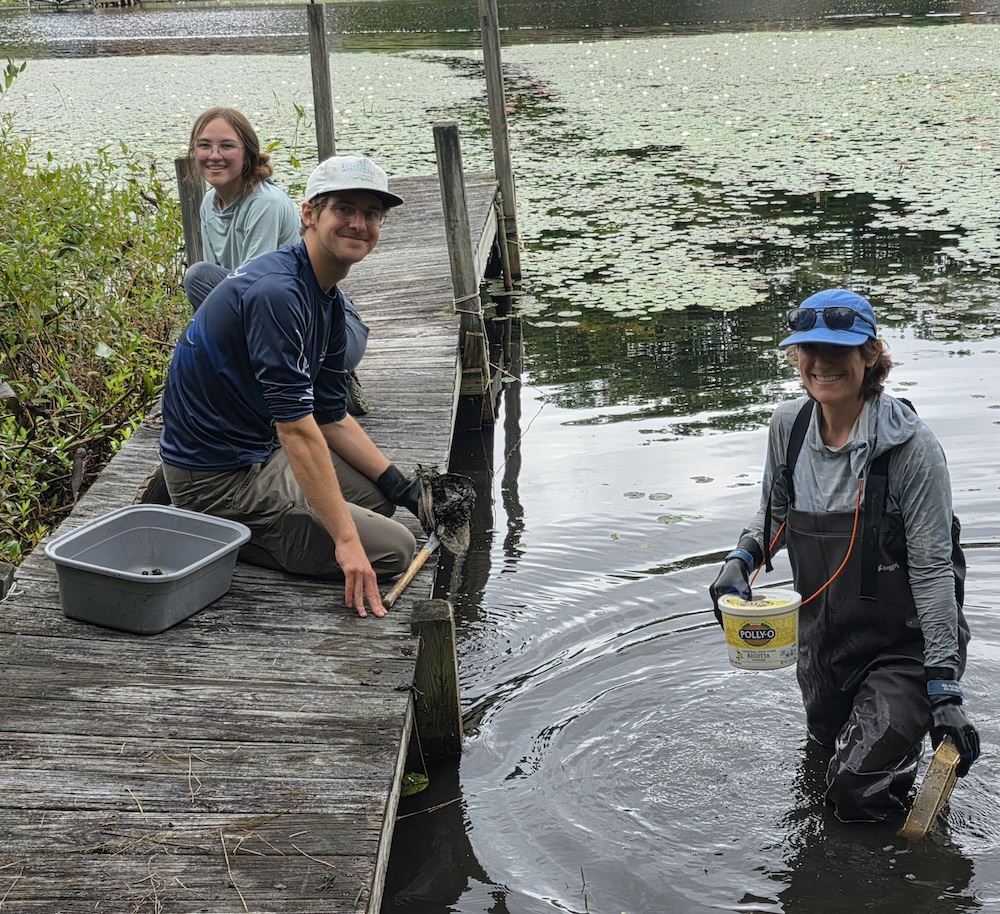
Hello LSC. We'd like to let you know about a Lake Champlain Basin Program funded project that made a stop at Lake St. Catherine this week. The good folks from Upstream Consulting & Evaluation reached out to the LSCA to inquire about setting up their 2 day project on a conveniently located parcel near the boat launch. We reached out to Catherine Oliverio of the Butternut Hill Community Association, as their lake property was the perfect spot, and Catherine not only agreed to allow the team to set up their project, but she also documented it with some photos and the article attached below!
Thank you to Catherine, Melanie and her team from Upstream Consulting, and the DEC for their efforts for LSC.
You can read about this aquatic invasive species (AIS) project, and the initial findings below in Catherine's article:
Project CLAM (Champlain Aquatics Monitoring)
By Catherine M. Oliverio
Project CLAM is a research project that is led by Upstream Consulting & Evaluation, LLC. The project team commenced testing and surveys on Lake St. Catherine Aug. 24, 2026 and completed their study Aug. 25. The sampling was part of a research project that is funded by the Lake Champlain Basin program.
The team collaborates with the invasives team at DEC, Vermont Department of Environmental Conservation, to prioritize sites for the research and share data. DEC’s mission is to preserve, enhance, restore and conserve Vermont’s natural resources and protect human health for the benefit of this and future generations.
Jerremy Jones of the Lake St. Catherine Association and the Butternut Hill Community Association’s lake parcel afforded the Project CLAM team an ideal spot near the public launch to conduct their study.
Team leader Melanie Giangreco, Olivia Walsh, and Rogan Poquette worked side by side setting crayfish traps and sifting through the muck for invasive banded mystery snails and native and invasive crayfish. While doing so they not only collected specimens but also documented and measured them. Anything found invasive has to be euthanized to avoid any further spreading and destruction to the habitat.
Natural habitats include mollusks (snails, mussels, clams) and crustaceans (crayfish and some plankton). These species filter water, clean debris, bacteria, algae, and more. Unfortunately, other species are brought to our waterways and can be invasive causing ecological or economic harm. The invasive rusty crayfish outcompete the native crayfish destroying vegetation and displacing local populations.
"We hope to learn more about invasive species and prevent them from spreading," stated Giangreco. "We want more healthy bodies of water."
This three-year program goal is to visit 90 sites such as lakes, rivers, and streams that feed into the Lake Champlain Basin documenting habitat characteristics including rocks and vegetation on the bottom.
She continued, "This is our second year of the project with 68 sites completed. Our current team began this summer and will complete the other sites next summer."
The team does have assistance from scientists and advisors on board with data analysis.
Poquette said, "We hope to make an impact and educate the public"
"I’d like to piggyback on what Melanie and Rogan said," commented Walsh. "I want the younger kids to learn about the environment and be more interested in native species."
Giangreco emphasized that no one should empty bait buckets into any body of water. Fortunately, the Lake St. Catherine Association takes the initiative to examine any and all boats for any signs of invasive species.
Here is a summary of what was found:
- Native Unionidae mussels (did not identify species but documented that they were present)
- 1 invasive snail species (Banded Mystery Snails)
- 3 native snail species
- 1 invasive crayfish species (Rusty Crayfish)
- 1 additional introduced/non-native crayfish (Virile Crayfish—these are widespread throughout the region, but are not native to Lake St. Catherine)
- 1 native crayfish (Calico Crayfish)
Knowing your aquatic community is important to protect freshwater habitats leading to more enjoyable, swimming, fishing, hunting, viewing or photography in wildlife or simply being outdoors. Clean water and healthy ecosystems are key for such activities.